The problem rarely starts with the spreadsheet.
A spreadsheet can organize customers, orders, inventory, tasks, costs, and metrics. For many companies, it's exactly the right tool to start with.
The problem shows up when the operation starts depending on dozens of tabs, shared files, formulas, messages, and the handful of people who know exactly where a given piece of information lives.
Information
Tools
People
Decisions
At that point, the company doesn't necessarily have a spreadsheet problem.
It has a process problem.
What signals the real problem is how complex the operation has become,
not how big the spreadsheet is.
Four signs tend to show up first in the operation.
01 Misaligned data
Three people open the same file, and each one sees a different number.
When several people need to check, update, or validate the same data, control starts depending on manual discipline. That's exactly where it starts to break down.
02 Fragmented process
The order comes in on WhatsApp, gets jotted down in the spreadsheet, and confirmed by email.
The process runs through four or five tools that don't talk to each other. No one holds the whole operation in one place, just pieces of it.
03 Repetitive work
Someone spends the first hour of the day copying information from one place to another.
Updating statuses, checking data, sending the same messages, putting together the same report. It's work that happens every day and moves the business forward by exactly nothing.
04 Delayed decisions
Monday's meeting starts with someone consolidating the spreadsheet.
When data has to be pulled together by hand before a decision can be made, the decision always arrives after the moment it mattered most.
When an operation needs to be constantly organized by someone, maybe it needs to be organized by software.
What changes when a process becomes a system
In the spreadsheet
- Information scattered across files
- Manual updates
- Individual formulas and controls
- Dependence on specific people
- Manually prepared reports
In the system
- Centralized information
- Automated processes
- Rules defined in the system
- Reproducible processes
- Information available the moment it's needed
This doesn't mean abandoning the spreadsheet. There are processes where it's still the simplest, most appropriate solution. Forcing a system where a spreadsheet already works just trades one problem for another.
The decision point comes when the cost of keeping a manual process running starts to outweigh the benefit of sticking with a tool built to organize data, not to run an entire operation.
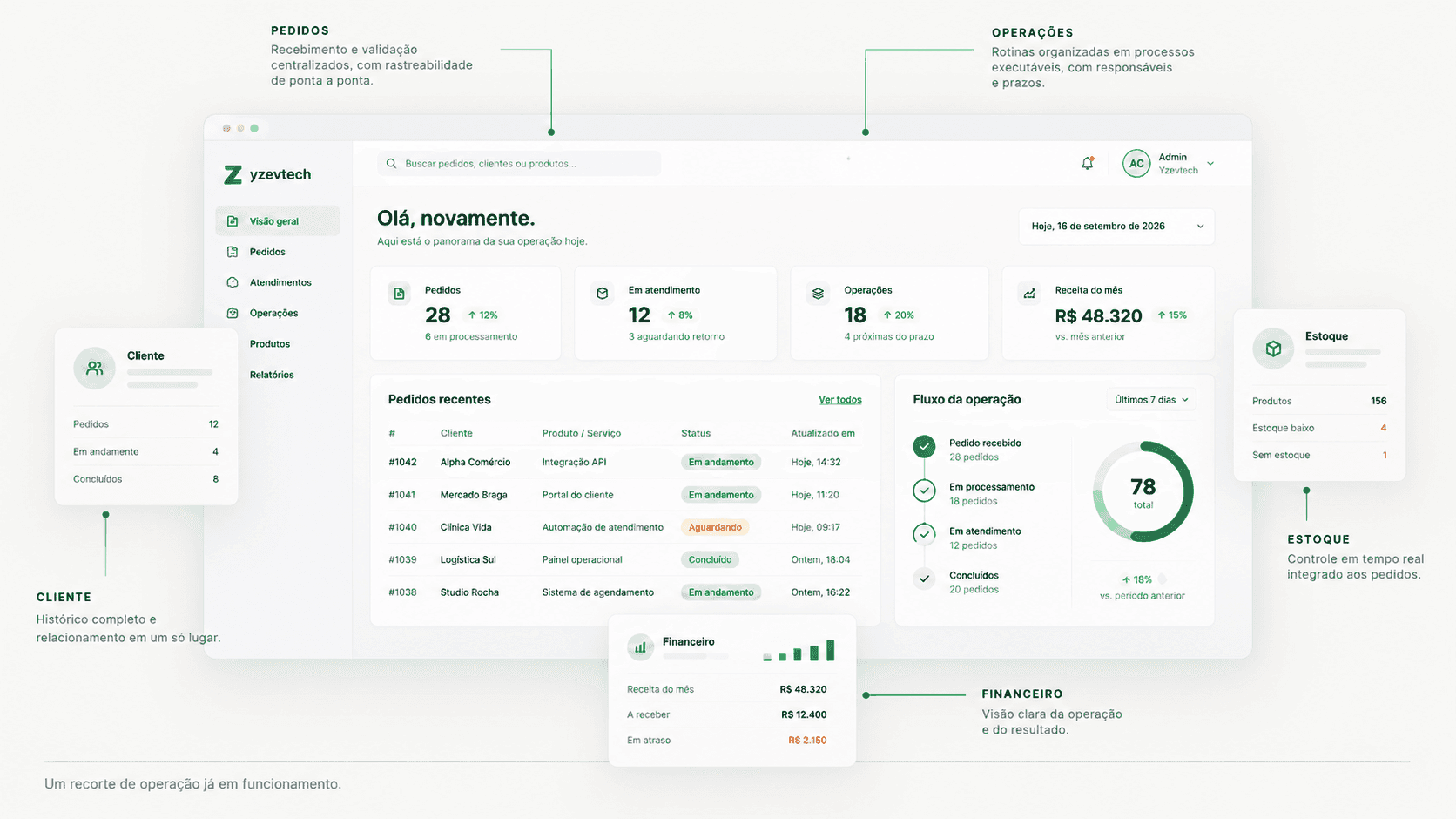
The problem you're trying to organize might already be a product.
Not every problem needs a system. But some processes stop working well once they depend on too many manual controls.
Orders
Receive, validate, distribute, track and update automatically.
Support
Centralize requests and keep every interaction as a trackable step.
Operations
Turn repetitive routines into executable processes.
Management
Consolidate information from different areas.
Tracking
Know what happened, who did it, when, and what comes next.
Custom systems
Build a tool when off-the-shelf solutions don't reflect how the business actually works.
Does your process still fit in a spreadsheet?
The problem isn't about file size. It shows up when information, process, people, and decisions start demanding too much manual control.
When that happens, switching tools rarely fixes it. The next step is rethinking how the work actually happens.
Keep reading